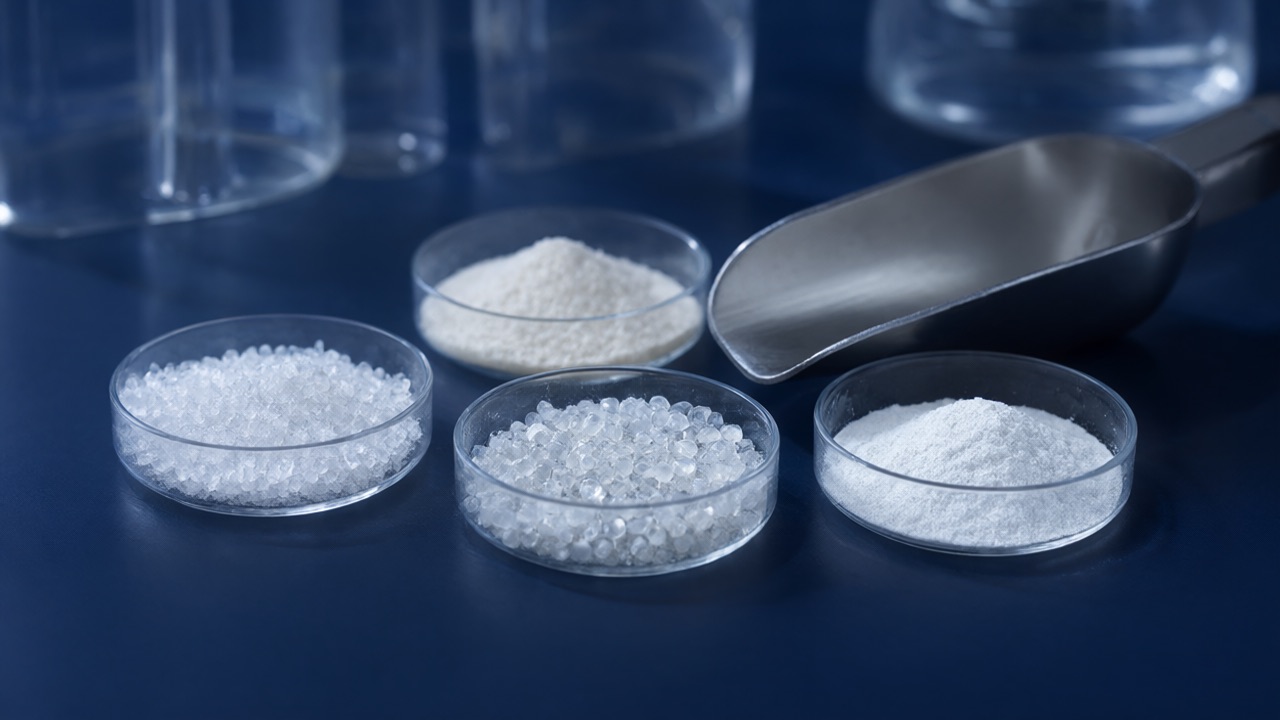
A failed part rarely fails for one reason. Heat during processing, oxygen over its shelf life, UV in service, a fire code at the customer — each threat has its own additive family, and the final formulation is a system of compromises. This guide maps the four families every compounder should keep straight: what each one does, where it does not help, and how they interact.
Antioxidants: Two Roles, Two Battles
Antioxidants protect against thermal oxidation, and they split into two complementary roles. Primary antioxidants (hindered phenols such as AO-1010 and AO-1076) donate hydrogen to interrupt the chain reaction; secondary antioxidants (phosphites like AO-168) decompose the hydroperoxides before they multiply.
Processing stages — extrusion, molding, recycling passes — consume phosphites first; long-term aging leans on the phenol. That is why the classic 1:1 to 1:2 antioxidant blends dominate: the melt history and the service life are two different battles.
UV Absorbers: The Optical First Line
Benzotriazoles (UV-326), benzophenones (UV-531) and triazines convert 300–380 nm photons into harmless heat before bonds cleave. They cannot repair damage, and their shield is never complete — which is why they are the first line, not the only line. Browse the UV absorber range by polymer compatibility and food-contact status.
HALS: The Regenerating Second Line
HALS (hindered amine light stabilizers) do not absorb UV at all; they scavenge the radicals that appear once degradation starts, and they regenerate while doing it — a 0.2–0.3% loading can multiply outdoor life several-fold. Low-MW grades migrate (good for films), oligomeric grades resist extraction (good for fibers and thin films). See the light stabilizer family for the full grade map.
Flame Retardants: Answering a Different Regulator
Fire codes, not sunlight, drive this family. Halogen-free systems — phosphinates, nitrogen–phosphorus intumescent packages, melamine derivatives — have taken the lead in electronics, appliances and construction as RoHS and eco-labels tightened. The selection variables are LOI target, UL94 rating needed, processing temperature and the smoke/toxicity profile. Our flame retardant line covers both polyolefin and engineering-resin grades.
The System View: Where Formulations Are Won
Additives interact — and this is where formulations are won or lost:
- Absorbers compete with pigments for photons (strongly pigmented parts should bias HALS)
- Acidic fillers can poison HALS
- Recycling passes multiply the antioxidant demand
- Even the colorant matters — pigment chemistry sets the lightfastness ceiling no stabilizer package can raise. Our group's plastics colorant portal lists pigment grades with their fastness classes: see the organic pigments category at Aolong Chemical
A Five-Step Selection Workflow
- Fix the resin and processing window
- Name the exposure — indoor, outdoor, food contact, E&E
- Choose the FR package if the market demands one
- Build the stabilization from the outside in — HALS/UVA for service life, antioxidants for the melt history
- Verify in the final matrix, at final pigment loading — additive interaction is why step 5 exists
Send us your resin, geography, processing temperatures and warranty target — our engineers will propose a starting package across all four families and supply trial quantities within a week.