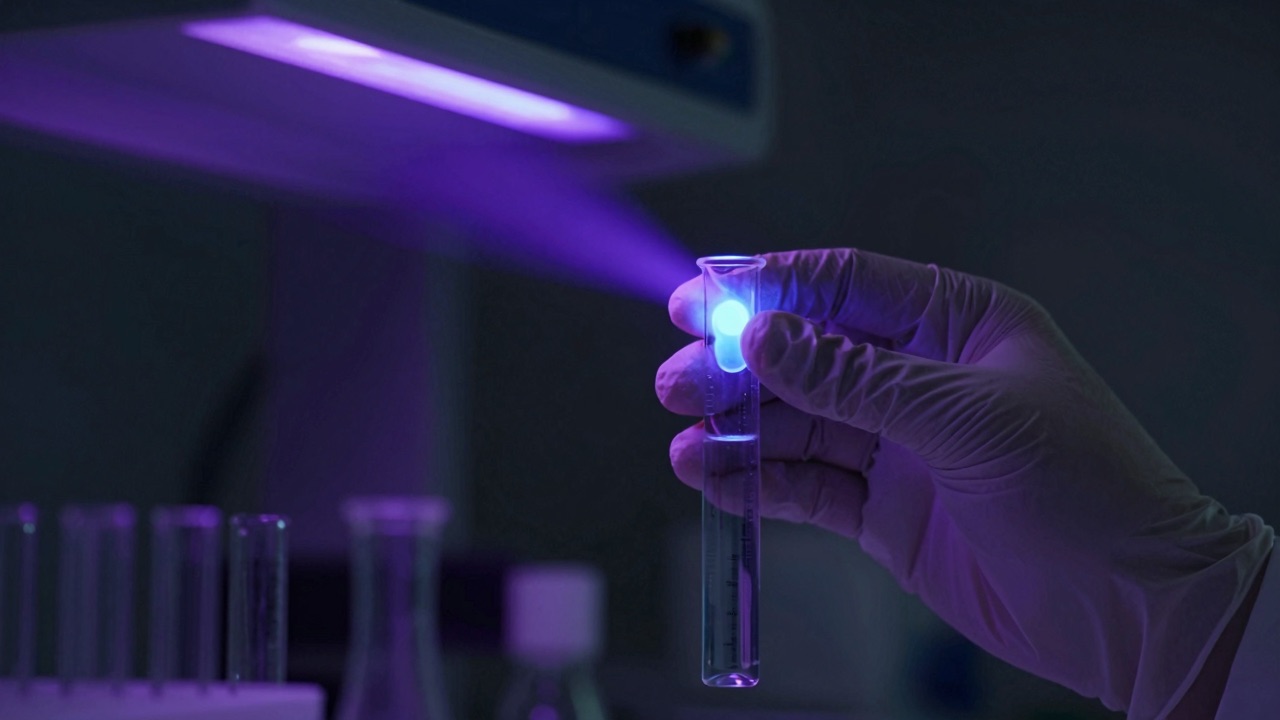
Migrating a formulation from mercury lamps to UV LED is not a lamp swap — it is a chemistry change. Mercury emission is rich in 254 and 313 nm energy where alpha-hydroxy ketones work well; LED arrays emit a narrow band at 365, 385, 395 or 405 nm, and most of a mercury-era package simply goes unused. Here is the framework our application engineers use when advising customers.
Step 1 — Match Absorption to Wavelength
At 395–405 nm, only acylphosphine oxides (TPO, TPO-L, 819) and thioxanthones (ITX) have meaningful absorption. A formulation built on 184 or 1173 alone will dramatically undercure; keep them as 10–30% co-initiators for surface cure, not the backbone.
Step 2 — Pick the Phosphine Oxide for Your Geometry
- TPO-L — clear or lightly pigmented films up to ~50 μm; easiest handling, lowest color.
- 819 — white or heavily pigmented systems; its two chromophores deliver measurably deeper cure (in our testing, 1.5% 819 outperforms 2% TPO through 150 μm of TiO2-loaded white paint).
- TPO — the middle path: stronger in depth than TPO-L, cleaner in color than 819.
Step 3 — Add Synergists Deliberately
A small ITX fraction (0.2–0.5%) widens effective absorption; amine synergists like EDB counter oxygen inhibition at the surface. Watch total acid: amine packages can yellow white coatings over time, so validate post-cure color at 7 and 30 days, not just at line speed.
The Three Mistakes We See Most
- Overloading initiator — above ~4% total, unreacted initiator plasticizes the film.
- Ignoring photoinitiator purity — by-products absorb uselessly and discolor.
- Testing under the wrong lamp during development.
One more selection factor: functional inks. Color-changing systems — photochromic and thermochromic pigments in particular — absorb in the same UV region your initiator needs, so cure depth and color effect must be tuned together. Our group's specialty portal ThermoColors curates a functional color-changing inks portfolio that pairs well with the initiator guidance above.
Send us your system — oligomer, pigment loading, film thickness and target line speed — and our engineers will propose a starting package with samples within one week.